About DW-8K
The Korg DW-8000 arrived during one of the most exciting periods in synthesizer history. Digital technology was transforming electronic music, enabling entirely new sounds and ways of creating them. Yet analog synthesizers still possessed something musicians weren't ready to give up: the warmth and expressive character of real voltage-controlled filters and amplifiers. The DW-8000 brought these two worlds together in an exceptionally powerful and versatile instrument.
Introduced in the mid-1980s, the DW-8000 was an eight-voice programmable polyphonic synthesizer built around Korg's Digital Waveform Generation System, or DWGS. Rather than relying entirely on the familiar sawtooth, square, and pulse waves of traditional analog synths, the DW-8000 provided 16 digitally generated waveforms with considerably more varied harmonic character. These included conventional synthesizer waveforms alongside complex tones inspired by acoustic instruments such as pianos, organs, guitars, brass, and strings.
Two independent digital oscillators per voice allowed musicians to combine these waveforms, adjust their relative tuning, and create sounds that would have been difficult to achieve with conventional analog oscillators alone. But instead of sending these digital waveforms through an entirely digital synthesis engine, Korg routed them through analog voltage-controlled filters and amplifiers. The result combined the distinctive harmonic structures of digital waveforms with the familiar warmth and tonal shaping of analog subtractive synthesis. This meant that bright, metallic, and harmonically complex waveforms could be softened into lush pads, shaped into punchy basses, or swept through resonant filters to produce animated, evolving timbres. The instrument could sound unmistakably digital one moment and surprisingly analog the next, often finding its most interesting territory somewhere between the two.
The DW-8000 also offered more sophisticated sound shaping than its relatively modest control panel might suggest. Independent six-stage filter and amplifier envelopes provided more flexibility than conventional ADSR designs, while oscillator autobend, a modulation generator, velocity sensitivity, and keyboard aftertouch added even more expressive possibilities.
Its built-in digital delay was another key ingredient. Capable of producing chorus, flanging, and delay effects, it gave the DW-8000 an additional dimension of ambience and movement. An integrated arpeggiator, MIDI implementation, and programmable patch memory further established the instrument as an extremely capable performance and production synthesizer.
That said, programming the original required patience. Rather than providing a dedicated knob for every function, the DW-8000 relied on numbered parameters, an edit slider, buttons, and small numerical displays. The underlying synthesis architecture was versatile and rewarding, but exploring it wasn't always easy or immediate.
Nevertheless, the DW-8000 earned an enduring reputation for its distinctive sound. Its combination of digital harmonic complexity, resonant analog filtering, complex envelopes, and rich modulation effects gave it a musical personality that remains appealing even today.
____________________________
Korg is a registered trademark of Korg Inc. There is no association, affiliation or endorsement of Cherry Audio or its products by Korg Inc.
Enter Cherry Audio's DW-8K
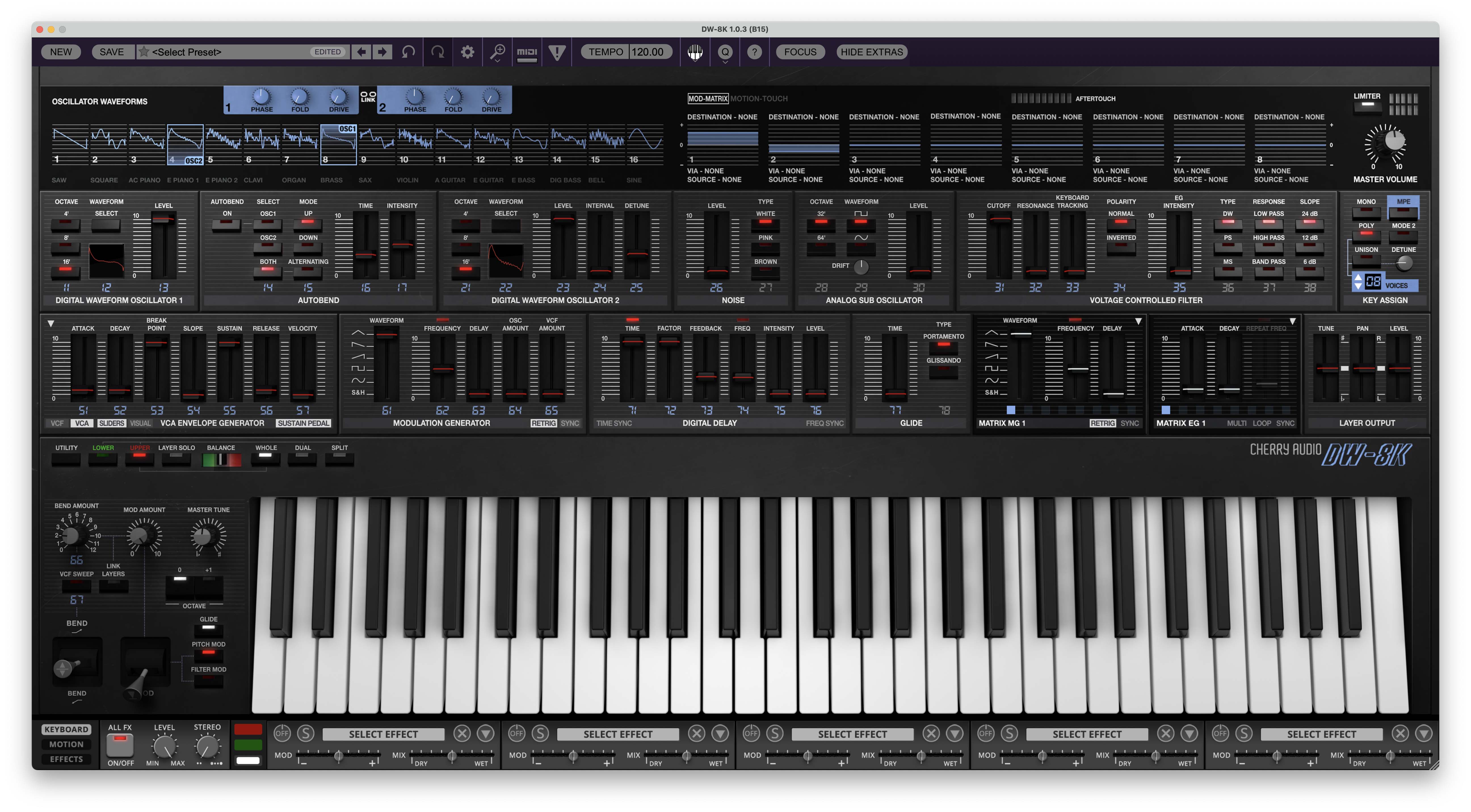
Cherry Audio's DW-8K brings the character and distinctive synthesis approach of the original Korg instrument into a modern software synthesizer, while expanding its capabilities far beyond what was practical on the original hardware. At the heart of DW-8K are two digital waveform oscillators drawing on the DW-8000's characteristic 16-waveform architecture. The original instrument's oscillator tuning, autobend, analog-style filtering, six-stage envelopes, modulation generator, and digital delay provide a familiar foundation for exploring its distinctive hybrid sound.
But Cherry Audio hasn't simply recreated the original instrument's interface. DW-8K presents its synthesis controls on an expansive, hands-on panel where oscillators, filters, envelopes, modulation, and performance settings are immediately accessible. The sound-design process becomes more visual and direct, inviting experimentation without requiring musicians to memorize parameter numbers or navigate menus for every adjustment.
And there's even more to explore. DW-8K expands the oscillator architecture with additional waveform-shaping controls, an analog-style sub oscillator, and additional noise sources. Expanded filtering, modulation generators, a flexible modulation matrix, and expressive performance controls provide new possibilities for shaping and animating sounds.
A dual-layer architecture makes it possible to combine contrasting or complimentary timbres, create elaborate layered sounds, and construct keyboard splits. Modern performance features, including expanded MPE support, extend the instrument's expressive capabilities, while an integrated arpeggiator, polyphonic sequencer, parameter animation, and comprehensive effects processing provide powerful tools for adding still more movement, rhythm, and depth.
These additions make DW-8K considerably more versatile than its hardware ancestor while preserving the appeal of combining digital waveforms with subtractive synthesis.
The instrument's interface is organized around three main views:
Keyboard View provides an onscreen keyboard and performance controls for playing, auditioning, and shaping sounds in real time.
Motion View brings together the arpeggiator, sequencer, and parameter animation tools for creating rhythmic patterns, evolving sequences, and animated sound textures.
Effects View provides dedicated processing chains for the Upper and Lower synth layers, along with Global effects for shaping the combined sound.
Together, these views make it easy to move between creating a sound, performing it, bringing it to life with motion, and adding the finishing polish with a broad palette of effects.
Key Features
Dual-layer operation with independent sound settings, keyboard splits, layering, dedicated effects processing, and up to 16 voices per layer.
Two digital waveform oscillators featuring 16 selectable DWGS-style waveforms, additional waveform-shaping controls, oscillator tuning, and autobend
An analog-style sub oscillator and multiple noise types for adding weight, texture, and additional harmonic complexity
Expanded voltage-controlled filter modeling with resonance, keyboard tracking, envelope modulation, and selectable filter responses
Flexible six-stage filter and amplifier envelopes for creating detailed tonal and amplitude contours
Multiple modulation generators and a versatile modulation matrix for creating everything from subtle movement to complex, evolving sounds
The original instrument's distinctive digital delay architecture, complemented by an expanded collection of modern effects
Expressive performance features including velocity response, aftertouch, MPE, glide, and multiple voice assignment modes
An integrated arpeggiator, step sequencer, and parameter animation tools for creating rhythmic and evolving performances
Three independent effect chains with 25 studio-quality effects, including the astounding new Crush, Shimmer, and Sculpt effects
A comprehensive preset browser, MIDI controller mapping, and support for standalone operation or use as a plug-in inside a compatible DAW
Import original DW-8000 programs with SysEx or cassette data backup (as WAV files) via drag-and-drop
Getting to Know DW-8K
One of the pleasures of DW-8K is how much sonic territory can be explored with just a few controls. Start with a single digital oscillator and audition its waveforms. Notice how dramatically the harmonic character changes as you move between conventional synthesizer shapes and the more complex instrument-inspired waves. Open the filter to hear each waveform's full character, then gradually lower the cutoff and listen to how the sound changes.
Add the second oscillator and experiment with its interval and detune controls. Small tuning differences can create richness and movement, while larger intervals introduce entirely new harmonic relationships. Adjust the filter envelope to give the sound a sharp attack, a gentle swell, or a slowly evolving contour. Then introduce modulation or digital delay to add movement and dimension.
These simple experiments reveal much of what made the original DW-8000 special. Its sound wasn't defined by one particular oscillator waveform, filter setting, or effect. It emerged from the interaction of all these elements, particularly the way digitally generated harmonics responded to analog-style filtering and modulation.
Cherry Audio's additions provide even more territory to explore, but there's no need to master everything at once. Begin with the basic sound-generating architecture, learn how the filter and envelopes shape it, and introduce additional modulation, layers, sequencing, and effects as your musical ideas develop. Whether you're recreating the distinctive sounds of the original DW-8000 or exploring entirely new territory, DW-8K offers plenty of opportunities for discovery.
The chapters that follow explain each section of DW-8K in detail, with practical examples and sound-design techniques to help you make the most of the instrument.
Technical Assistance
Cherry Audio provides several resources to help with installation, authorization, software operation, and technical questions.
The Cherry Audio Forums are useful for general questions, sound-design discussions, product information, and advice from other Cherry Audio users.
For account, installation, authorization, or technical issues requiring direct assistance, contact Cherry Audio Technical Support.
Cherry Audio Forums: https://forums.cherryaudio.com/
Cherry Audio Technical Support: https://cherryaudio.kayako.com/
The next chapter, Getting Started, covers installation, authorization, audio and MIDI configuration, controller setup, and the quickest route to making your first sounds with DW-8K.