Getting Started
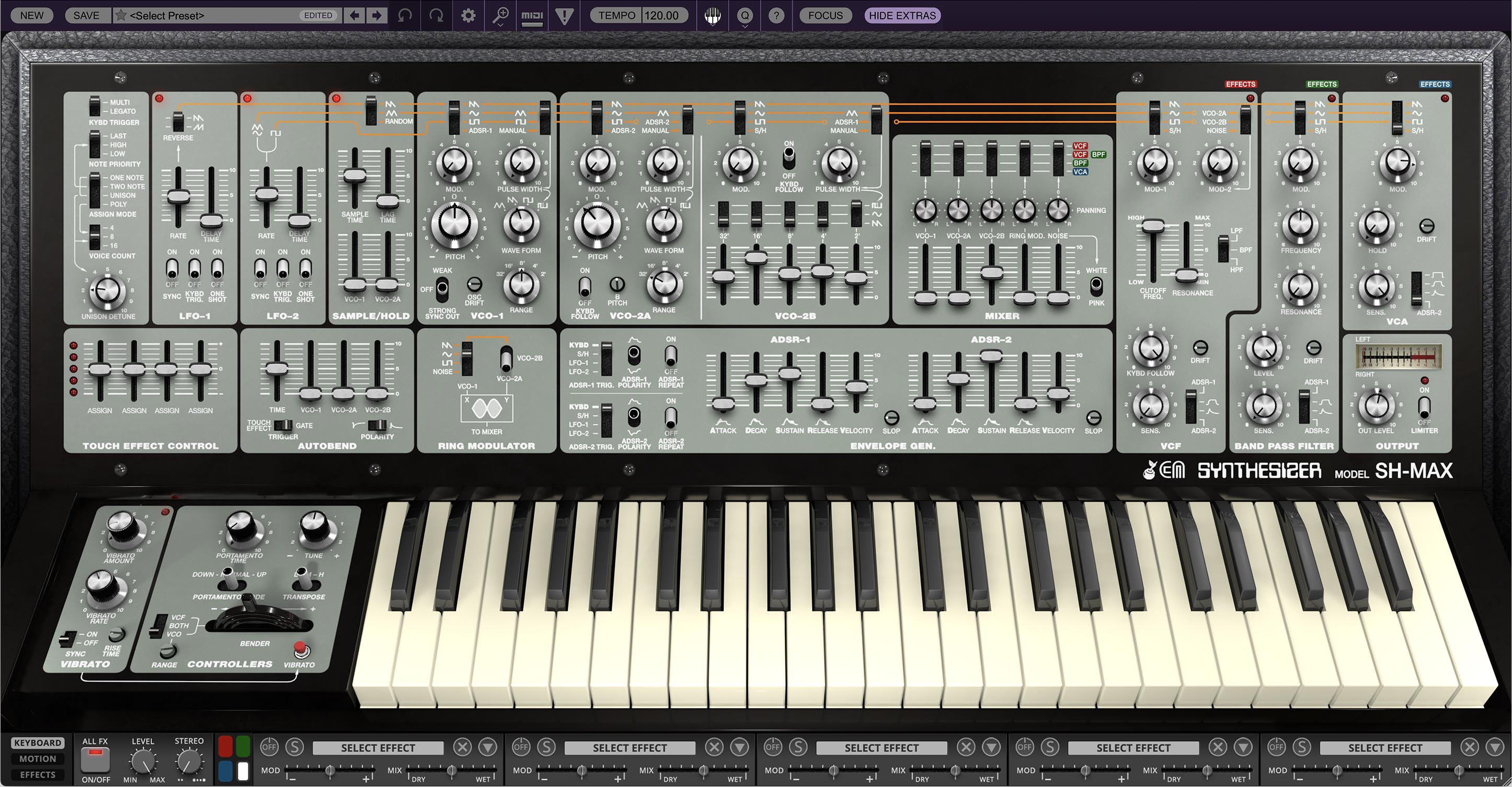
SH-MAX is Cherry Audio’s love letter to three of the SH-series synthesizers: the SH-5, SH-7, and SH-3/SH-3A. But true to form, SH-MAX isn't a by-the-numbers reinvention by any stretch of the imagination. It’s more like we took the best traits of each SH model, added a bunch of uber-useful feature tweaks and additions, then handed you the keys and said, “Crank it up and take it out for a spin.”
At its core, SH-MAX is SH-5-focused where it’s most important: big oscillators, a bold filter section, and a hands-on sound architecture. Then it spices things up with SH-7-inspired features like Autobend, extra oscillator options, plus some SH-3A flavor (its additive-style oscillator) that adds even more character. We've even added a "touch" (so to speak) of the SH-2000's touch effect capability, and a sequencer inspired by the Model 104.
The first thing you’ll notice about SH-MAX is its filter personality. It doesn’t really do polite. Push its resonance and it quickly goes from analog warmth to angry beast. It’s especially good at raw, fat tones that cut through a mix without needing a boost from a stack of plug-ins (though we've included those too, if you need them).
The second thing you’ll notice is how alive it is. One of the classic SH-5’s quirks was a bandpass filter that had a lot of character, but not much in the way of modulation. SH-MAX kicks that door open wide. The bandpass section isn’t a static tone shaper here, it’s a sound-in-motion machine. If you like sounds that talk, sizzle, and emote, you’re going to spend quality time in this part of the panel.
Then there’s the Cherry Audio secret sauce that turns SH-MAX into a sound designer’s lab: the VCF, BPF, and VCA paths each have their own dedicated effects chains. That means you can process different parts of the synth’s signal flow independently, like a mini studio built into the instrument. Distort just the bandpass path for snarling mids while keeping the main filter clean. Add phase movement pre-amplifier, then smear it all together with a wash of reverb or delay post-amplifier. Or do something irreverant like turning the bandpass into a gritty, moving layer that floats on top of a stable low-passed tone.
Finally, SH-MAX also brings SH-style versatility into a modern world. You can run it like a classic mono synth, stack it for thick unisons, or use fistfuls of polyphony when you want its aggressive voice to play chords instead of just plucking out bass lines.
Some SH-Series History
The SH-series sits in a sweet spot in synth history. The SH synths came along late enough that their designers had learned what mattered to working musicians, but early enough that things weren’t completely standardized yet. The result was a run of instruments that feel a little like modular thinking in a suitcase. They were great-sounding, flexible instruments, with a bias toward sounds that cut through a band mix.
The SH-3 (1974) and SH-3A (1975) are the early-shape-of-things-to-come models. They’re monophonic, but don’t sound small. One of their unique calling cards is an organ-like harmonic mixer. Instead of a single oscillator waveform at a single octave, you get more of a drawbar-style, build-your-own-harmonics vibe (which you still run through a classic subtractive signal path). The SH-3A’s personality is also evident in its modulation. Specifically, two LFOs and a quirky Sample & Hold section (labeled “SAMPLER,” because the ’70s were still the Wild West). In other words, it’s a player’s synth that can still get weird. Even the SH-3 vs. SH-3A filters have a unique story. Sources say that the two versions used different filter designs (diode-style vs. transistor ladder-style), which is why you still hear people argue about which one sounds better.
Then the SH-5 (1976) shows up and is loaded with hands-on playability and a signal path that encourages you to sculpt sound. That design matters. It’s a big part of why the SH-5 still feels modern when you’re in front of it. And historically, it landed right when pop and new wave were learning how to make synths the rhythmic engine of a track, not just a novelty layer. In Blondie’s “Heart of Glass,” Jimmy Destri used the SH-5 to help build its irresistible. driving beat.
The SH-7 (1978) is the rarer, more ambitious sibling. It’s designed like a serious performance instrument, but even more importantly it was duophonic and a bridge between monophonic performance synths and the polysynth explosion that followed. Its semi-modular vibe is a big reason that SH obsessives still talk about it like it’s a secret weapon.
Culturally, the SH lineage connects genres that otherwise don’t share a lot of DNA. New wave and pop artists used SH synths to make rhythm and hooks feel futuristic without losing punch. Industrial and experimental artists used them because the SH approach encourages edginess in the form of tune drift, filter bite, and interesting modulation.
This is the lineage SH-MAX inherits and enhances, then does what software is great at: expanding the tonal palette, expanding functionality, and making the whole experience available inside a modern production environment without needing a road case or a dedicated tech for maintenance and repairs.
Technical Assistance
Cherry Audio's unique online store and automatic updating should make operation a smooth experience, but if you run into any issues or have questions, you can discuss issues online at the Cherry Audio forums.
... or you can communicate directly with one of our surly and grumpy outgoing and friendly tech support staff at: