About Pentaphonic
Some synthesizers become classics because they were everywhere. The Gleeman Pentaphonic became one because it almost wasn’t anywhere at all.
Introduced in the early 1980s by brothers Bob and Al Gleeman, the Pentaphonic was created in Mountain View, California, during an extraordinary period in synthesizer history. Bob Gleeman wanted the sound and flexibility of the emerging programmable polyphonic synthesizers of the day in a smaller, more portable instrument. His brother Al, a computer hardware designer, approached the problem from the engineering side and developed an unusual five-voice synth built around three oscillators per voice, analog filtering and amplification, modulation, envelopes, chorusing, and a compact 37-note keyboard. Later versions added programmable patch storage and other refinements.
The Pentaphonic arrived at a key moment in electronic instrument history. Synths such as the Sequential Circuits Prophet-5 had established programmable polyphony as the new standard, while a rapidly growing generation of Japanese synthesizers was about to make polyphonic instruments more affordable and widely available. MIDI and the digital synthesizer revolution were just around the corner. The Pentaphonic appeared in that narrow space between eras, combining the sonic impact of an American polyphonic analog synthesizer with an unusually computer-oriented design of its own.
Then there was the Pentaphonic Clear. As if building one of the rarest synths of the era wasn't distinctive enough, Gleeman Instruments built an eye-catching transparent version housed in clear acrylic. Intended in part for stage use, the Clear exposed the instrument’s internal circuitry instead of hiding it behind metal and wood. The result looked less like a conventional keyboard and more like something from a science-fiction film.
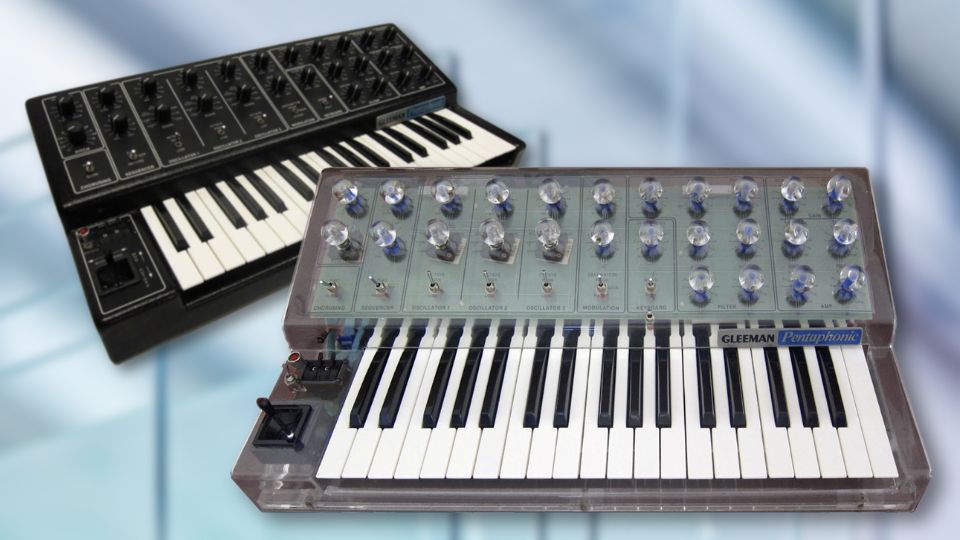
Only a very small number of Pentaphonic instruments were ever produced, and surviving examples are now prized by collectors. Exact production totals vary among historical sources, but there’s little disagreement about the instrument’s rarity. Rarity alone, however, wouldn’t have sustained the Pentaphonic’s reputation. Its sound did that.
Players who encountered the original were struck by its unusually rich sonic character: sharp, three-oscillator leads, rich, chorused, strings, warm resonant filtering, and a clarity that distinguished it from many of its competitors. Former Gleeman dealer Joey Swails remembered the instrument as exceptionally beautiful sounding, particularly for lush pads and strings. Jazz pianist Oscar Peterson was reportedly so taken with a Pentaphonic after encountering one in a San Francisco-area music store that he spent roughly two hours playing it before grabbing one for himself.
That combination of sound, scarcity, unusual engineering, and personality has made the Pentaphonic an object of fascination for synthesizer collectors and historians. It has also created an obvious problem: very few musicians have ever had the opportunity to actually play one.
But Cherry Audio's Pentaphonic changes that.
Cherry Audio has rescued this remarkable instrument from relative obscurity and a handful of surviving vintage examples, to faithfully translate its distinctive character into software, where musicians, producers, sound designers, collectors, and synth aficionados can explore it for themselves.
But the goal wasn't to simply preserve a rarity. Pentaphonic puts its three-oscillator architecture, rich polyphonic character, expressive filtering, modulation, and unmistakable early-'80s personality inside a modern instrument designed to be played, programmed, recorded, and expanded way beyond what was practical or even possible on the original hardware.
There’s a certain poetic justice in that. The original Pentaphonic began because Bob Gleeman wanted an extraordinary synthesizer that was easier to take with him. And now it fits inside a laptop.
Key Features
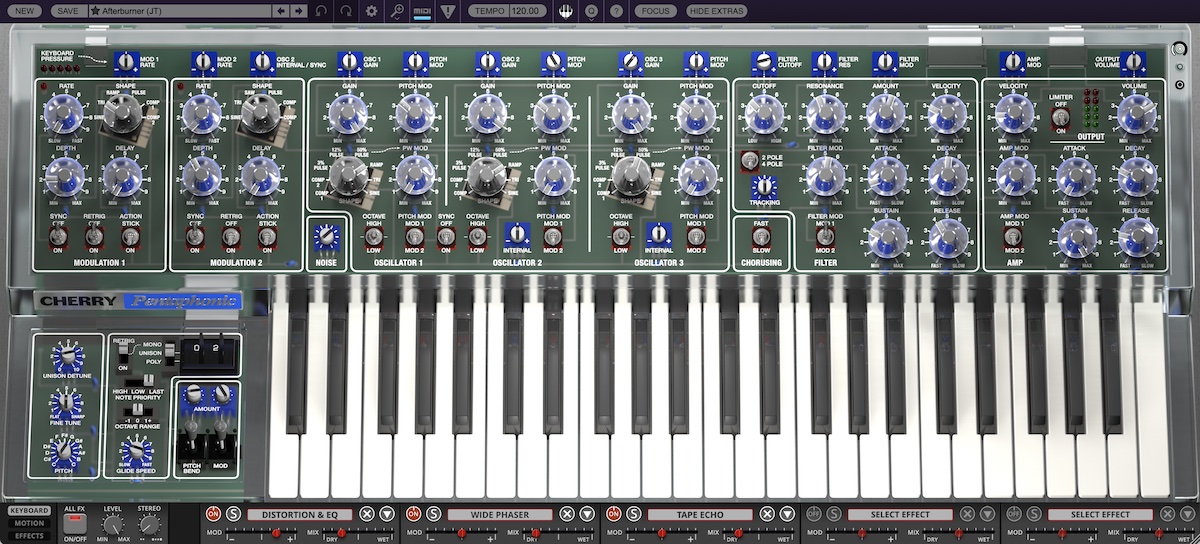
Pentaphonic combines the distinctive architecture and character of the original Gleeman instrument with the convenience and enhanced capabilities possible in a modern softsynth.
Highlights include:
Three oscillators with independently selectable wave shapes, levels, tuning relationships, and modulation
Two versatile modulation sections for creating vibrato, pitch movement, pulse-width animation, filter modulation, and other evolving effects
Three stunning UI themes, including two clear panel designs with controllable opacity, inspired by the various looks the Pentaphonic sported during its existence
Switchable 2-pole and 4-pole filtering with resonance, keyboard tracking, envelope modulation, and velocity response
Independent Filter and Amp ADSR envelopes
Performance controls for pitch bend, modulation, glide, tuning, note priority, polyphonic and unison operation, and unison detuning
Built-in chorusing for classic width and movement
Integrated effects processing for expanding the original instrument into modern production territory
MIDI controller mapping and Cherry Audio’s current MIDI Learn system
Standalone operation or plug-in use inside a compatible DAW
You can understand a great deal of the instrument simply by following the signal from the oscillators through the filter and amplifier, then adding modulation, performance control, and effects as needed.
Technical Assistance
Cherry Audio’s installation, authorization, and automatic-update systems are designed to keep setup straightforward. If you encounter a problem, help is available through the Cherry Audio user forums and technical support system.
The Cherry Audio Forums are useful for general questions, sound-design discussions, product information, and advice from other Cherry Audio users.
For account, installation, authorization, or technical issues requiring direct assistance, contact Cherry Audio Technical Support.
Cherry Audio Forums:
https://forums.cherryaudio.com/
Cherry Audio Technical Support:
https://cherryaudio.kayako.com/
The next chapter, Getting Started, covers installation, authorization, audio and MIDI configuration, controller setup, and the quickest route to making your first sounds with Pentaphonic.