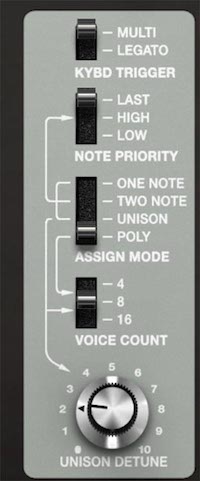
Voice Modes and Unison
This panel is where SH-MAX decides how it plays, meaning whether it behaves like a classic mono synth or a poly, how it stacks voices in unison, how it chooses which note wins when you’re holding more than one key, and how thick the unison stack gets when you want maximum size.
KYBD TRIGGER (MULTI / LEGATO)
Controls whether the envelopes retrigger when you play overlapping notes.
MULTI
Each new note retriggers the envelopes. Use this for plucks, sequences, and anything where you want a clear attack on every note.
LEGATO
If you play a new note while still holding another, the envelopes don’t retrigger. Pitch changes to the new note while the first envelope contour continues. This is the classic legato lead behavior and feels especially expressive for fluid lines.
NOTE PRIORITY (LAST / HIGH / LOW)
Determines which note plays when more than one key is held, primarily in ONE NOTE and UNISON modes.
LAST
The most natural for lead playing. The most recently pressed key takes priority.
HIGH
The highest held note takes priority. Great for classic lead technique: hold a lower note and pull out higher melody notes without letting go. Especially effective with a bit of portamento.
LOW
The lowest held note takes priority. Useful for bass lines when you want the bottom note to stay anchored even if you hit higher keys.
ASSIGN MODE (ONE NOTE / TWO NOTE / UNISON / POLY)
Determines how voices are allocated when you play.
POLY
Standard polyphonic behavior for chords and multi-note playing. Voice Count (below) can be set to 4, 8, or 16 voices.
UNISON
Stacks multiple voices on a single note. This is the mode for massive leads, basses, drones, and sound-design hits. VOICE COUNT sets the number of stacked voices, and UNISON DETUNE (below) sets how wide and animated that stack feels.
TWO NOTE
A two-note”play mode that lets you play intervals, fifths, and two-note riffs with a more direct, performance-synth feel than full poly.
ONE NOTE
Classic mono behavior. When multiple keys are held, NOTE PRIORITY decides which pitch you hear.
VOICE COUNT (4 / 8 / 16)
Sets how many voices are stacked when ASSIGN MODE is set to UNISON or POLY. For Unison, think of this as the thickness control:
4 voices = focused and punchy
8 voices = wide and powerful
16 voices = impossibly huge, dense, and animated
Because VOICE COUNT increases the number of voices stacked per note, higher settings can be more CPU-hungry, especially with effects.
UNISON DETUNE
Controls how far the unison voices are detuned from each other. Lower settings add subtle width and motion. Higher settings push into obvious beating, chorusing, and that classic, earth-splitting, "All glory to the hypo-toad!" (shameless Futurama reference) roar.
Tip: Use small detune for thick basses and leads. Use higher detune for drones and hero leads where you want size and impact.
Practical Examples
Big unison lead
ASSIGN MODE: Unison
VOICE COUNT: 8
UNISON DETUNE: start low, increase until it thunders
KYBD TRIGGER: Legato for smooth phrasing, Multi for punchy re-attacks
Tight bass
ASSIGN MODE: One Note
NOTE PRIORITY: Low
KYBD TRIGGER: Multi (usually)
Use minimal Unison, or switch to Unison with 4 voices for manageable thickness.
Two-note power intervals
ASSIGN MODE: Two Note
NOTE PRIORITY: Last (usually feels best)