Envelope Generators ADSR-1 and ADSR-2
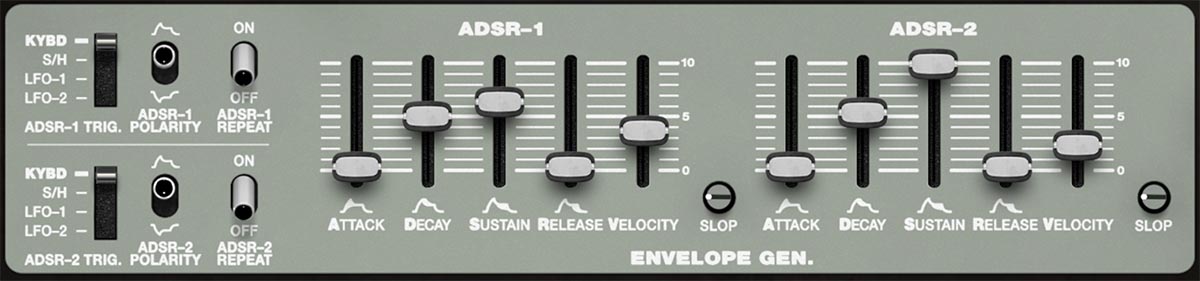
SH-MAX’s envelopes are like little motion engines you can aim at different destinations, trigger in unusual ways, and set into repeating behavior. SH-MAX gives you two full ADSR envelopes: ADSR-1 and ADSR-2. They’re broadly similar, but the trick is how flexibly you can use them:
Choose which envelope drives the VCF and/or BPF (via each filter’s ADSR select switch and SENS control).
Add expressive performance with Velocity response.
Flip the envelope direction with Polarity.
Loop the envelope with Repeat.
In certain modes, choose what triggers each envelope (KYBD, S/H, LFO-1, LFO-2).
Note: ADSR Trig isn’t available in Poly mode. The ADSR-1 TRIG and ADSR-2 TRIG trigger-source selectors are not available in Poly mode. You’ll only see/use them in Unison, One-Note, or Two-Note modes (as shown on the panel).
Controls
ADSR
Attack: how quickly the envelope rises after it triggers.
Decay: how quickly it falls from peak down to the sustain level.
Sustain: the level held while the gate is active.
Release: how quickly it falls to zero after the gate ends.
Tip: Don’t dial envelopes in isolation. With SH-MAX’s parallel routing (VCF + BPF, dual BPF possibilities), the same ADSR can read as a totally different gesture depending on where it’s landing.
Velocity
Velocity sets how much the envelope responds to how hard you play (or incoming MIDI velocity).
Low Velocity: consistent plucks/pads. Great for sequences and tight parts.
High Velocity: more expressive tone movement. Great for leads, bass, anything you want to play like an instrument instead of trigger like a machine.
Tip: Velocity on a filter envelope is basically “performance EQ.” Let your hands open the tone instead of babysitting cutoff.
Slop
Slop adds random variation to the envelope so that each trigger isn’t a perfect photocopy of the last one. Think of it like oscillator drift, but applied to envelope behavior.
Low Slop: subtle variations. Note triggering and contours feel less identical.
Higher Slop: more unpredictability. Good for organic textures, less great for tight EDM stabs.
Tip: If a patch feels sterile, add a little Slop both here and in the Oscillator and VCA sections. (Note that it's called "Drift" there.)
Polarity
Polarity flips the envelope’s direction (positive vs. inverted), which is huge when you’re shaping a sound.
Normal polarity: classic behavior (envelope opens things up on attack).
Inverted polarity: flips the gesture (for example: start brighter and clamp down, or start narrow and bloom depending on routing and SENS).
Practical uses:
Inverted filter envelopes can create tension: the sound gets grabbed right after the hit.
Use normal on one filter lane and inverted on another to create motion that feels like depth.
Repeat
Repeat loops the envelope (it retriggers itself). This turns an ADSR into a rhythmic motion source that can feel more intentional than an LFO, because it has a hit, a fall, and a return.
What it’s good for:
Rhythmic filter pulses while you hold notes.
ADSR-shaped cycles that feel more complex than a simple repeating LFO.
Subtle repeated emphasis that keeps pads moving.
Tips:
Keep the depth modest at first (via the destination SENS). A little looping movement sounds musical. Too much can sound like an auto wah.
For percussive pulses: short Attack, short Decay, low Sustain, then Repeat ON.
Trigger source (ADSR-1 TRIG / ADSR-2 TRIG)
Each envelope can be triggered by:
KYBD: normal key-gate triggering.
S/H: irregular retriggers for “events” instead of steady wobble.
LFO-1 / LFO-2: rhythmic retriggers driven by an LFO.
These controls are available only in the non-Poly voice assign modes, and are otherwise grayed out.
Tips:
LFO trig + Repeat OFF: clean rhythmic plucks that keep their ADSR character.
LFO trig + Repeat ON: can get wild fast. Start subtle unless you’re deliberately designing a malfunctioning robot heartbeat.
S/H trig is best at low modulation depths. Subtle irregular motion feels natura. Big irregular motion feels like a special effect.
Practical Tips
Classic subtractive
ADSR-2: amp (VCA)
ADSR-1: filter (VCF)
Add a little Velocity to ADSR-1, less to ADSR-2.
Two-stage articulation
ADSR-1: fast snap (short A/D)
ADSR-2: slow bloom (longer A/D)
Route one envelope primarily to VCF and the other to a BPF lane for a delayed vowel.
Repeating envelope as an ADSR LFO
Repeat ON
Short A, medium D, low S, tastefully-set R
Use it for pulsing bandpass layers under pads.