Mixer + Routing Overview
If SH-MAX were a normal synth, we'd be starting our explanation of its features with a discussion of its oscillators. But SH-MAX isn't just any synth. It's both unique and uniquely powerful. That's why we're covering its mixer and signal routing concepts first.
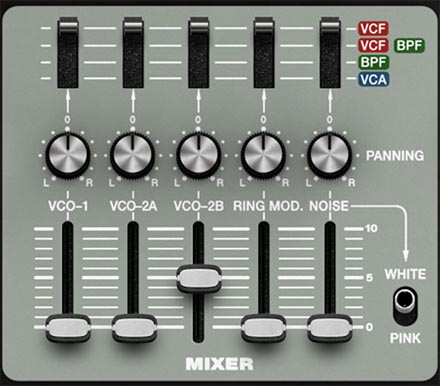
On most synths, the mixer would be the part you set once then mostly ignore. But on SH-MAX, the mixer is where sound design starts, because it doesn’t just mix. It determines what each sound source becomes. Every one of the five sources (VCO-1, VCO-2A, VCO-2B, Ring Mod, and Noise) has its own level fader, stereo pan control, and a routing switch that chooses what signal path that source will travel through.
The routing switches are key. They let you send each source to:
VCF: Send the source to the main filter (whose mode is set in the VCF section: LPF, BPF, or HPF).
VCF + BPF: Split the source into two parallel filter paths. The signal goes to the VCF and to the dedicated Band Pass Filter at the same time, and the outputs are mixed together.
BPF: Send the source only to the dedicated Band Pass Filter.
VCA: Send the source straight to the amplifier, bypassing both filters entirely.
Here’s the big conceptual shift: SH-MAX isn't simply one filter you run the whole synth through. It’s more like a parallel tone-lane instrument where you can decide, per source, whether you want it filtered, band-focused, wide open, or layered through multiple filter characters at once.
And because each path (VCF, BPF, and VCA) has its own effects chain, routing isn’t just tonal. It’s architectural. You’re not only shaping frequency content, you’re choosing which processing lane a sound lives in.
Why this Routing Makes SH-MAX So Powerful
Most subtractive synths force your entire signal through one filter stage, so your job is to choose a single cutoff and resonance setting for everything. But SH-MAX doesn’t make you compromise. You can treat the oscillators like separate instruments sharing a keyboard. One oscillator can be clean and direct for punch.
Another can be lowpassed and animated for body.
Noise can be bandpassed for breath or grit.
Ring Mod can be filtered into a metallic halo instead of a full-spectrum clang.
Or you can split a source to VCF + BPF and get two different filter personalities in parallel, blended into one composite tone.
This approach changes how you program patches. You’ll often start by asking, “Which lane should each source live in?” before you touch filter cutoff or envelopes.
Tip: Think “roles,” not “oscillators.”
Before moving a knob, decide what each source is doing. For example:
VCO-1: weight, punch, fundamental
.
VCO-2A: bite, detune, animation
.
VCO-2B: octave body, organ/string stack, stable reinforcement.
Noise: air, breath, sizzle, percussive edge.
Ring Mod: metallic clang, tension, dirt
Then route each role to the path that makes sense: VCA for pure, unfiltered punch, VCF for sculpted weight, BPF for focused character, VCF+BPF for layered complexity.
Quick Reference
Each sound source gets its own Level, Pan, Routing controls.
Routing choices:
VCF: goes to main filter (mode = LPF/BPF/HPF in VCF section)
BPF: goes to the dedicated band-pass filter
VCF+BPF: splits to both filters in parallel and mixes the results
VCA: bypasses filters entirely
And remember,
VCF, BPF, and VCA are parallel paths.
Each path has its own effects chain.
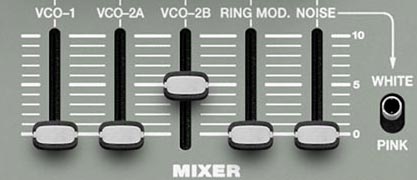
Source Level Faders
The five vertical faders set the level of each source feeding the downstream routing. These are your gain staging controls. In SH-MAX, level matters more than usual because you may be feeding multiple parallel paths and mixing their outputs.
Practical note: when you route a source to VCF+BPF, you’re effectively generating two processed versions of that same source and summing them. So patch loudness can climb fast. This is normal behavior.
Tip: Build patches at conservative levels.
Start with each active source fader around the mid area, then bring them up once the routing and filtering are set. You’ll make better decisions, and you’ll avoid accidentally biasing yourself toward louder is better.
Source Panning Knobs
Each source has its own L/R pan control. This is not just for stereo spread, it’s a sound design tool. Hard-pan oscillators for big width without chorus.
Keep fundamental content centered while spreading higher layers.
Pan noise slightly off-center to create space.
Since SH-MAX’s effects are per path, panning also helps you keep those effect returns from feeling like a dense, mono blob.
Tip: Center the power and widen the texture.
Keep the source that carries the fundamental (often VCO-1 or VCO-2B’s 16’/8’) centered.
Pan the character layers outward: VCO-2A, higher VCO-2B footage, noise textures, ring-mod harmonics.
This keeps bass solid while the patch feels expansive.
The Routing Switches
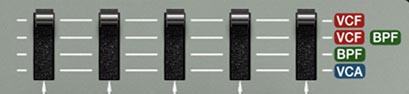
Above each pan knob is a small multi-position routing switch. This is the heart of the mixer.
For each source, choose one destination:
VCF: main filter path (mode chosen in the VCF section: LPF/BPF/HPF)
VCF+BPF: split to both filters in parallel and sum the outputs.
BPF: dedicated band-pass filter path only
VCA: bypass filters and go straight to the amp.
Because routing is per source, you can build hybrid structures inside a single patch that would normally require layering multiple synth instances.
Tip: Don’t treat VCA as a bypass, treat it as direct injection.
Routing to VCA is a creative move. It gives you a clean, immediate layer that can keep a patch present even when the filtered layers are heavily animated. That said, you may need to keep its level relatively low so as not to overwhelm the other elements.
How the VCF and BPF interact when you route VCF+BPF
When you select VCF+BPF, SH-MAX sends the same input signal to both filters in parallel. The filter outputs are mixed together. They do not feed into each other.
This matters a lot, because parallel filtering behaves very differently than series filtering. Parallel tends to sound larger and more layered, because you’re hearing two tonal interpretations at once.
Series tends to sound more carved or narrowed, because the second stage further filters what the first stage already shaped.
SH-MAX gives you the parallel behavior, which is great for richness and complexity without sacrificing energy.
Tip: Parallel filters are mix-ready.
If a patch sounds a little flat, try routing one key source (often VCO-2A or noise) to VCF+BPF, then use:
VCF for weight (LPF or HPF depending on the patch)
and BPF for character focus (narrower, resonant, sits in the track).
That combination can make a patch feel finished without needing external EQ tricks.
The Two Bandpass Filters Trick
If you set the VCF to BPF mode, and you route a source to VCF+BPF, you’re running that source through two bandpass filters at once. And they’re not the same filter. Their architectures differ, so they have different tone and resonance behavior. That’s a real SH-5-ish personality quirk, and it’s one of those things that’s hard to fake with generic plug-in chains.
In practice, this means you can do
a wide bandpass in the VCF to define the main body
and narrower, more peaky bandpass in the dedicated BPF to add a vocal-like formant or bite
. Then blend them by how you set the two filters.
Tip: For formant and talking synth tones, route VCO-2A to VCF+BPF.
Set VCF to BPF with moderate resonance and a lower center frequency (the “throat”).
Set the dedicated BPF a bit higher with higher resonance (the “mouth”).
Now sweep one filter slowly while the other stays fixed. You’ll get vowel-ish shifts that sound like the synth is trying to speak.
Routing Examples
Here are some practical ways to use the mixer.
1: Bass that stays punchy even with filter movement
VCO-1: route to VCA (centered), low to moderate level
VCO-2A: route to VCF (LPF), slight detune, moderate level
Noise: route to BPF (very low level), subtle character
Now you can animate the LPF cutoff on VCO-2A for movement without losing the immediate transient and fundamental from VCO-1.
Tip: This is the “don’t disappear on small speakers” setup.
A filtered bass can sound amazing solo and vanish in a mix. The VCA direct layer prevents that when used strategically.
2: Wide polysynth without chorus mush
VCO-1: VCF (LPF), pan slightly left
VCO-2A: VCF (LPF), pan slightly right
VCO-2B: VCA, centered, using 16’ and 8’ for steady body
Now your stereo width comes from panning, not modulation smear. VCO-2B’s divide-down, phase-locked stack gives you a stable center that feels substantial and solid.
Tip: VCO-2B can be your glue oscillator. Because its octave lanes are perfectly in tune and phase-locked, it can reinforce a sound.
3: String synth vibes with controllable brightness
VCO-2B: VCF+BPF
Use 8’ + 4’ + 2’ lanes (mix to taste), choose waveforms per lane for tone
VCF set to LPF to provide overall softness
Dedicated BPF set higher to add a focused bowed-string attack edge
This can get you that classic string ensemble sound while still letting you dial back harshness.
Tip: Use BPF as presence EQ that moves with the sound.
Instead of boosting highs with EQ, add presence by blending in the bandpassed layer. It stays musical as you play up and down the keyboard.
4: Metallic ring-mod texture that doesn’t color the whole mix
Ring Mod: route to BPF only
. Set BPF frequency where it reads as tone rather than noise
Keep Ring Mod fader lower than you think
Meanwhile, keep VCO-1 routed to VCF or VCA as the stable anchor
. This gives you clang and sheen without the full-range chaos ring mod can produce.
Tip: Bandpass can be ring mod’s best friend.
Most ring mod patches fail because the result is too broadband. BPF turns it into a controllable instrument.
5: Drum and noise design inside a synth patch
Noise: route to BPF
Set BPF resonance and frequency to snare zone or hi-hat zone
Route an oscillator to VCF or even VCA for body tone.
Now your patch can contain both pitched and noise percussion elements with independent shaping.
Tip: A lead patch with a tiny, bandpassed bit of noise can feel percussive and alive, even at low levels.
How This Should Change Your Workflow
Here’s the practical approach that will make SH-MAX feel fast instead of overwhelming:
Choose sources and set rough levels.
Decide routing per source before touching filters.
Ask which sources need sculpting? Which should stay direct? Which deserve parallel filtering?
Set VCF mode (LPF/BPF/HPF). This defines what VCF routing really means.
Dial in VCF and BPF as two different tone shapers.
Think of VCF as main shaping, BPF as character focus, unless you’re intentionally flipping that.
Pan sources for width and separation.
Only then, start getting fancy with modulation and envelopes.
This routing-first mindset is why SH-MAX can feel like three synths living in one panel.
Tip: If you’re lost, mute.
Pull all faders down. Bring up one source at a time.
Choose its routing.
Set its pan.
Then add the next source.
SH-MAX rewards disciplined building.